GST Registration in India
The Goods and Services Tax (GST) was introduced in India in July, 2017 to replace many indirect taxes like VAT, Service Tax, Excise Duty, and other taxes. It combined these into one single tax and made the system simpler and easier to manage. GST registration is required for traders, service providers, manufacturers, and freelancers.
This new tax system has reduced confusion, stopped the problem of paying tax on tax, made it harder to avoid taxes and helped businesses to grow more easily, which has improved the country’s economy. In this article, you’ll get complete detail regarding GST Registration including its benefits, documents required, procedure, fee structure, etc.
Get your GSTIN without the portal hassle
- We prepare and file your application on the GST portal for you
- Help with clarifications if the GST officer raises a query
- Guidance on invoices, HSN/SAC codes and your first returns
What is the GSTIN Number?
GSTIN stands for Goods and Service Tax Identification Number. It consists of 15 alphanumeric digits and you identify the number in this pattern. Following is the detailed format of GSTIN:
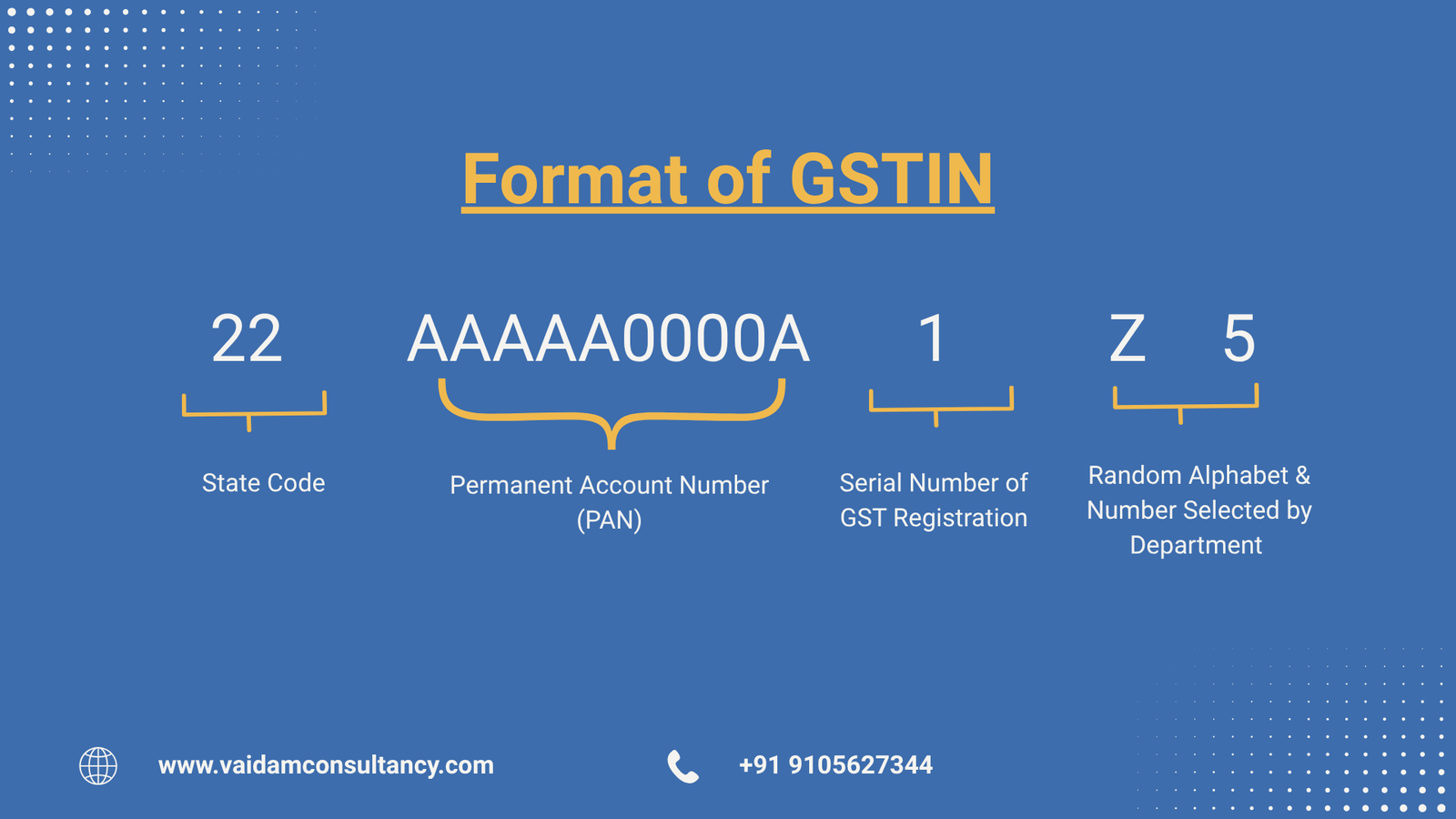
Is GST Registration Mandatory for You?
There are certain cases where GST Registration is mandatory. Following are the situations where GST Registration is mandatory:
1. Mandatory limit: Mandatory to get GST Registration when annual turnover exceeds INR 40 Lakh for product based business and 20 lakhs for service provider.
2. Causal taxpayer: If someone supplies goods or services in events/exhibitions where you do not have a permanent place of business, you need to get registration for GST before starting a business. The validity of causal GST Registration is 90 days.
3. NRI taxpayer: NRI who does not have a place of business in India, Planning to start a business in India, then he has to apply for GST Registration in India before beginning operations.
4. E-Commerce business: If someone is planning to start business on online platforms (such as Amazon or Flipkart) needs to be enrolled under GST whether the turnover is zero.
5. Inter state supply: If someone is carrying business in multiple states must get registered before starting operations.
6. Export of goods or services: If someone wants to export any goods or service must need to register under GST.
Benefits of GST Registration
There are numerous benefits one can get through GST Registration. Following is the list of benefits under GST Registration in India:
1. Legal Shield: GST Registration gives your business a legal shield by enabling them to take legal action against customers or suppliers in case of non-payment or non-compliance.
2. Legal authority: GST Registration provides you legal authorization for the business to operate freely.
3. Credibility: GST Registration Increases the credibility of business with customers, suppliers and other related fields.
4. Extra Edge: GST registration gives your business an extra edge to grow the business as you are one step ahead from your competitors.
5. Simple tax system: GST Registration makes your compliance process by eliminating the need for multiple registrations and reducing compliance costs.
6. Claim ITC: GST Registration allows your business to claim input tax credit on purchases of goods and services utilized for business purposes, which reduces your tax liability.
Documents Required for GST Registration
To register for GST (Goods & Service Tax), following is the list of documents required:
1. PAN Card: Pan card of individual if it’s a sole proprietor and for company all Partners/Directors pan card is required.
2. Aadhaar card: Aadhar card of individual if it’s a sole proprietor and for company all Partners/Directors aadhar card is required.
3. Photograph: Photograph of an individual if it’s a sole proprietor and for the company all Partners/Directors photograph is required.
4. Email id & Mobile no: Email and contact details are required for gst registration.
5. Address proof of place of business: One address proof is required based on following scenarios:
Note: After submitting all documents, the GST Officer has the authority to raise the clarification to provide any other document before giving approval.
Extra documents required in case of company
Procedure for GST Registration
To get GST registration online certain steps are required to be followed. These steps are as follow:
Step 01: You can visit www.gst.gov.in and create your TRN (Temporary reference number) after providing your pan based details.
Step 02: Next, you have to login through TRN number, upload required documents and information regarding the applicant and business and submit the application.
Step 03:After submitting the application you will receive a hyperlink for Aadhar verification after 30 minutes of submission.
Step 04:Once you complete your verification, you will receive ARN (Acknowledgement reference number) on your mail and number.
Step 05:Now you can track your application though ARN number and it will take 7 working days to get approval from the department.
Step 06:After getting approval you will receive a temporary user ID and Password and you need to create a new user ID and Password.
Note: Tired of the complex GST registration process? Contact Vaidam Consultancy and enjoy worry-free registration in three simple steps.
Fees for GST registration
There is no government fee for registering a business using the GST Registration Portal. The process is completely free and fully online. However, the GST Registration process can be tiresome and time-consuming. Vaidam consultancy can make things easier for you. You can swiftly and hassle free obtain your GST registration.
We will also support you after you obtain your gst in terms of:
Difference Between Composition GST and Regular GST
Here is the detailed difference between Composition and Regular GST on the basis of Compliance, Tax Rate, Input Tax Credit, GST Return Filing, Tax Invoice, etc:
| Particulars | Composition GST | Regular GST |
|---|---|---|
| Compliance | Less compliance to safe small businessmen form filing gst returns | All compliance required |
| Tax Rate | Composition taxpayers need to pay nominal GST at a fixed rate of turnover, which starts from 1 to 6% | Tax rate for regular taxpayers on goods and services ranges from 0–28% |
| Input Tax Credit | Composition taxpayers cannot avail input tax credit benefit | Normal taxpayers can avail input tax credit benefit |
| GST Return Filing | Required to file a single return on quarterly basis | Required to file two returns every month |
| Tax Invoice | Cannot issue tax invoice to their customers | Can issue tax invoices to their customers |
What are HSN/SAC codes?
HSN and SAC codes are basically used to classify goods and services while making gst tax invoice and these codes define the nature of product or service.
1. HSN Code: Harmonized System of Nomenclature
- Used for: Classification of Goods
- Purpose: To classify all goods in a harmonized manner.
- Example: For Mobile phone we use 8517 and for Sugar we use 1701
2. SAC Code: Services Accounting Code
- Used for: Classification of Services
- Purpose: To classify the Services
- Example: For legal service we use 998211 and Advertising service we use 998361
How to Check GST Registration Application Status?
In order to check GST Registration Application Status, individual need to follow certain steps:
- Step 01: Visit the GST portal at www.gst.gov.in
- Step 02: Click on the Services tab and select the Registration option.
- Step 03: Click on the Track Application Status option.
- Step 04: Enter the ARN (Application Reference Number) received after aadhar Verification.
- Step 05: Enter the captcha code shown on the screen.
- Step 06: Click on the Search button to check the application status.
- Step 07: The status of the application will be displayed on the screen. It may show one of the following status:
a. Submitted
b. Pending for verification
c. Pending for clarification
d. Rejected
e. Approved
- Step 08: If the application is rejected, the reason for rejection will also be mentioned.
- Step 09: If the status is pending for clarification, the applicant needs to provide the required information and submit the application again.
- Step 10: Once the application is approved, the applicant will receive the GST registration certificate.
What is Input tax credit?
Input Tax Credit (ITC) under GST means you can reduce the tax you pay on output (sales) by the tax you already paid on inputs (purchases). Input ITC can be reduced from the GST payable on the sales by the taxable person only after filing GST return.
Let’s understand how to Claim GST Input Tax Credit (ITC) – With Simple example
Let’s say you run a business that sells cell phones
Your Transactions:
a. Purchased goods worth ₹1,00,000 + 18% GST : Means you paid ₹18000 GST Tax
b. Sold goods worth ₹1,50,000 + 18% GST: Means you collected ₹27000 GST Tax
| GST on sales (output tax) | ₹27,000 |
|---|---|
| GST on purchases (input tax) | ₹18,000 |
| Net GST payable to government | ₹9,000 (₹27,000 - ₹18,000) |
You claim ₹18,000 ITC, so you only pay the remaining ₹9,000
You cannot claim ITC on:
- Personal use items
- Blocked credits (like motor vehicles for personal use)
- If the supplier hasn't filed GSTR-1
Why Choose us for your Private Limited Company Registration?
We charge no hidden cost to Our leads, offering the after sale services to provide the necessary support that your business requires. We have experienced professionals who can assist you to get your GST Registration Certificate timely & hassle free. Connect with Vaidam Consultancy now for your GST Registration.
Conclusion
GST Regitration Certificate
Common Mistakes to Avoid
GST applications are often held up by details that are easy to get right the first time.
- Skipping Aadhaar authentication – Without it the application may go for physical verification, which takes much longer.
- Wrong or missing HSN/SAC codes – Incorrect codes lead to queries now and invoicing problems later.
- Weak principal place of business proof – Rent agreements without an NOC or mismatched addresses are a common reason for rejection.
- Registering in only one state – Businesses supplying from more than one state need a separate registration in each.
- Forgetting bank details after approval – Bank account details must be added to the GST portal soon after registration.
After You Get Your GSTIN
Display your GSTIN
Show the registration certificate at your principal place of business and GSTIN on the name board.
Issue GST-compliant invoices
Invoices must carry your GSTIN, the right tax rates and HSN/SAC codes.
File returns every period
GSTR-1 and GSTR-3B are due monthly or quarterly, including nil returns.
Keep records and reconcile
Match purchases with GSTR-2B so you only claim eligible input tax credit.
Frequently Asked Questions
GSTIN stands for Goods and Service Tax Identification Number. It consists of 15 alphanumeric digits and each GSTIN is distinguished from each other.
There are two types of GST , one is regular gst and second is composition gst, based on your business category and model.
The business who crosses the mandatory turnover limit of 40/20 lakhs must get GST registration.
Yes, GST registration is completely free if you do it yourself on the government's GST portal or professional fee will be charged if you hire a consultant.
The Central Board of Indirect Taxes and Customs (CBIC) is the authority that issues the GST Registration Certificate.
Yes. A residential address can be your principal place of business. You will need ownership proof or a rent agreement, plus a no-objection certificate if the property is not in your name.
You must file GST returns on time – usually GSTR-1 and GSTR-3B – even for months with no sales. Late or missed returns attract late fees and interest, so we can take care of your monthly or quarterly filings.
Yes. A business needs registration in every state or union territory from which it makes taxable supplies.
Yes. The registration certificate should be displayed at the principal place of business and the GSTIN shown on the name board.